
When you’re getting a custom T-shirt printed, the design is just one part of the decision.
The bigger question is how that design is actually printed.
Two T-shirts can look the same on screen, but feel completely different in real life. One might be thick and long-lasting. Another might feel softer but wear out faster. And often, the difference only shows after a few washes. When comparing screen print vs DTG vs DTF, the differences come down to print quality, feel, durability, and cost.
That’s why understanding screen print vs DTG vs DTF matters.
If you’re planning to order, you can explore our custom t shirt printing in UAE collection to see available printing options and styles.
In a place like UAE, where people order everything from bulk event tees to one-off personalised pieces, choosing the right printing method affects not just the look, but comfort, durability, and overall value.
Let’s break it down in a way that actually helps you decide.
Screen Print vs DTG vs DTF: Understanding the Methods
Before comparing, it helps to know how each method works in real use.
-
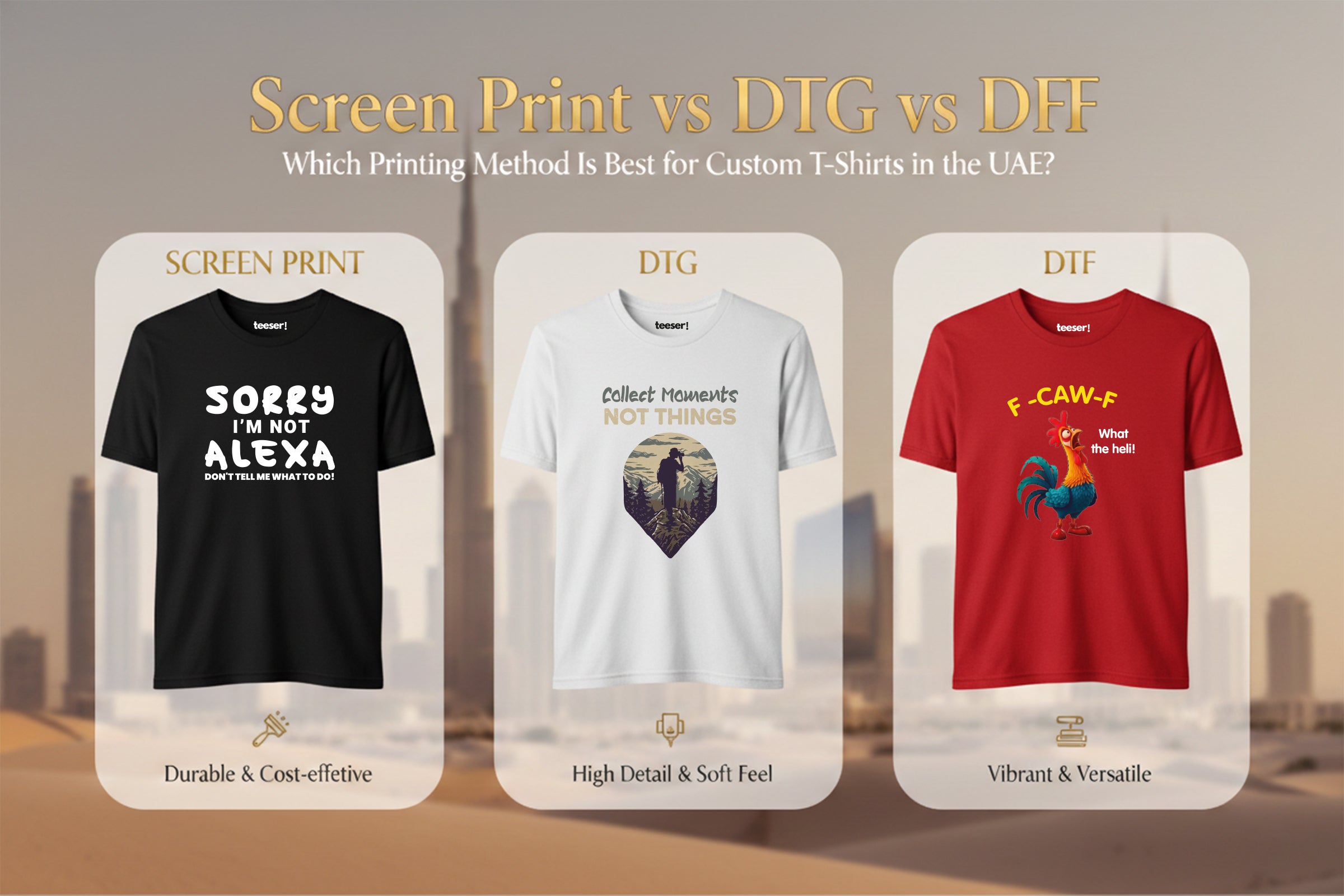
screen printing is the traditional method. Ink is pushed through a mesh screen onto the fabric, one colour at a time, and then heat cured. This creates bold, solid prints that sit on top of the T-shirt.
-
DTG works more like a fabric printer. The design is printed directly into the T-shirt using specialised ink, usually with pre-treatment and curing for better results.
- DTF prints the design onto a film first, then transfers it onto the fabric using a heat press. It’s a newer method that offers flexibility across different materials.
Each method is different and that difference shows in how your T-shirt looks, feels, and lasts. You can also browse our range of custom printed t-shirts based on your design and fabric preference.
Print Quality and Design Detail
The difference between screen printing and DTG becomes clear when you look at the design.
- Screen printing works best for clean, bold graphics like logos or text. It produces strong colours but isn’t ideal for complex artwork.
- DTG is better for detail. If your design includes gradients, shading, or custom photo printing on T shirts, it handles it with precision.
- DTF sits in between. It can manage both detailed artwork and vibrant color T shirt prints, making it a flexible option.
If your design is simple, screen printing works.
If it’s detailed or image-based, DTG or DTF makes more sense.
Print Feel and Comfort on Fabric
The feel of the print matters more than most people expect.
- Screen printing creates a slightly thicker layer of ink on the fabric. It’s durable, but you can feel it.
- DTG gives soft hand feel prints because the ink blends into the fabric. It feels lighter and more natural, especially for daily wear.
- DTF has a slightly raised finish due to the transfer layer, but it still remains flexible and comfortable.
If you’re looking for breathable, everyday comfort, DTG usually feels the best.
Durability and Wash Performance of Each Method
Which print lasts longer on T-shirts?
- Screen printing is known for strong print durability. It holds up well over time, especially for bulk screen printing Dubai orders.
- DTF also performs well in wash test results for prints, maintaining colour and structure after multiple washes.
- DTG can last too, but it depends heavily on proper pre-treatment and curing. Without that, fading can happen faster.
If long-term durability is your priority, screen printing and DTF are more reliable.
Fabric Compatibility and Use
Print methods for cotton vs polyester can affect your results.
- Screen printing works on most fabrics, including cotton and blends.
- DTG works best on cotton and is commonly used for high quality print T shirts UAE with detailed designs.
- DTF is the most flexible; it works well on cotton, polyester, and blended materials without much limitation.
If you’re printing on different types of fabric, DTF is usually the safest choice.
Cost and Order Size
Cost comparison print methods depend on how many T-shirts you need.
- Screen printing has a higher set up cost for screen printing because each colour requires a separate screen. But for large orders, it becomes very cost-effective.
- DTG has no setup cost, which makes it ideal for small batch T shirt printing UAE or even single-piece orders.
- DTF works well for both small and medium quantities, offering a balance between cost and flexibility.
If you’re ordering in bulk, screen printing is the better option.
For smaller runs, DTG or DTF is more practical.
Printing on Dark vs Light T-Shirts
Not all methods handle fabric colours the same way.
- Screen printing works well on both dark garments and light garments when done correctly.
- DTG requires extra pre-treatment for dark fabrics, which can affect cost and process.
- DTF handles both dark and light T-shirts easily, making it a reliable choice for mixed designs.
If your design is going on darker fabrics, DTF or screen printing is usually easier.
When to Choose Screen Print, DTG, or DTF
- Choose screen printing if you need bulk orders, simple designs, or durable T shirt printing Dubai for long-term use.
- Choose DTG when you want detailed designs, gradients, or custom photo printing on T-shirts with a softer finish.
- Choose DTF when you need flexibility across fabrics, vibrant colours, and consistent results without too many limitations.
So, Which Printing Method Is Best?
There isn’t one single answer.
The best printing method for custom T shirts depends on what you need.
- If your focus is scale and durability, screen printing works best.
- If you care about detail and comfort, DTG is the right choice.
- If you want flexibility and balanced performance, DTF is a strong option.
Most print shops don’t rely on just one method, they choose based on the design, fabric, and order size.
Conclusion
Choosing between screen print vs DTG vs DTF isn’t about picking a winner.
It’s about understanding what each method does well.
- Screen printing gives you strength and consistency for bulk orders.
- DTG gives you detail and a softer, more natural feel.
- DTF gives you flexibility across fabrics with reliable results.
Once you match the method to your purpose, the decision becomes simple.
Because a good custom T-shirt isn’t just about how it looks when it’s new, it’s about how well it holds up, how it feels to wear, and whether it still looks good after real use.